The design of generative AI and computer vision systems is often guided by technical in-lab evaluations that can differ substantially from real-world uses. This misalignment, at best, can lead to inefficiencies and, at worst, cause unintended harms in unforeseen contexts. Humans of Generative AI (HuG) recenters attention on the people who use and are affected by these systems. We invite talks and posters from human-centric research that inform the design or evaluation of generative AI and computer vision systems. Through this workshop, we will encourage and develop cross-disciplinary collaboration between computer vision and human-centric researchers, two often-disconnected communities.
Call for Participation
We invite poster and lightning talk submissions that document real-world use & impact of generative AI systems and/or leverage human insights to inform the technical design of generative AI and computer vision systems. We especially encourage interdisciplinary work spanning computer vision, machine learning, HCI, safety, security, ethics, and social science.
Poster and lightning talk submissions are open.
Submit by April 10, 2026 at 11:59 PM Anywhere on Earth.Important Dates
- April 10, 2026 - Submission deadline
- April 24, 2026 - Notification of acceptance
- May 22, 2026 - Camera-ready deadline
- All deadlines are 11:59 PM Anywhere on Earth
Submission Overview
- Who should submit: Researchers and practitioners who connect user insights to technical AI design and requirements
- What to submit: Title, 200-300 word abstract, a 1-page extended abstract, and a short practical relevance statement
- What to present: Accepted submissions will present a 3-5 minute lightning talk and a corresponding poster.
Expand submission details Hide submission details
Topics of Interest
We welcome submissions on the following themes:
Topic 1: Human-Centric Findings That Inform AI Design
As AI systems are adopted in everyday settings, they are often used in ways not anticipated by their designers. We welcome work that documents these real-world practices and their implications, including their use in creative writing, journalism, and the generation of sexual content, as well as their impacts on stakeholders due to the theft of intellectual content, and labor displacement. This can also include, but is not limited to:
- Human-subjects studies, including surveys and fieldwork, that inform AI system design
- Empirical findings about user needs, harms, trust, or adoption
- Design implications derived from qualitative or mixed-methods research
- Studies identifying mismatches between system assumptions and real-world use
Topic 2: Technical Designs for Unattended Real-World Needs
Technical standards, requirements, interfaces, or evaluation protocols may need to be adapted in response to observed real-world uses, unmet needs, or harms. We welcome work that explores how this technical gap may be addressed. This can include system designs that accommodate real-world use cases, novel protections against under-considered harms such as artistic style theft, or discussions of how to translate societal or policy goals into concrete technical processes.
- System designs grounded in user research and participatory elicitation methods
- Technical protections for impacted stakeholders
- Evaluation frameworks that translate societal or policy goals into AI technical processes or assessments
- Prototypes, tools, or workflows evaluated with real-world stakeholders
Submission Requirements
Each submission should include:
- Title
- Abstract of 200-300 words
- A 1-page extended abstract, with CVPR format recommended (no short abstract required).
- A short explanation of which workshop topic best fits the submission and how the contribution helps the audience understand how AI systems are used, misused, or experienced in practice
Submissions should be made through OpenReview.
Presentation
Accepted posters are also expected to give a 3-5 minute lightning talk during the workshop. The final talk length will depend on the number of accepted submissions. At least one author of each accepted submission must attend the workshop to present the poster and lightning talk.
We will publish a list of accepted posters and their abstracts on the workshop website.
Workshop Policy
Submissions do not need to be anonymized. The workshop is non-archival and will not appear in the CVPR proceedings.
Schedule
Times are listed in Denver local time (MDT).
Organizers
Jaron Mink
Arizona State University
David A. Forsyth
University of Illinois–Urbana-Champaign
Elissa M. Redmiles
Georgetown University
Sarah Adel Bargal
Georgetown University
Shawn Shan
Dartmouth College
Lucy Qin
Georgetown University
Anand Bhattad
Johns Hopkins University
Shiry Ginosar
Toyota Technical Institute at Chicago
Eunice Yiu
University of California, Berkeley
Downloads
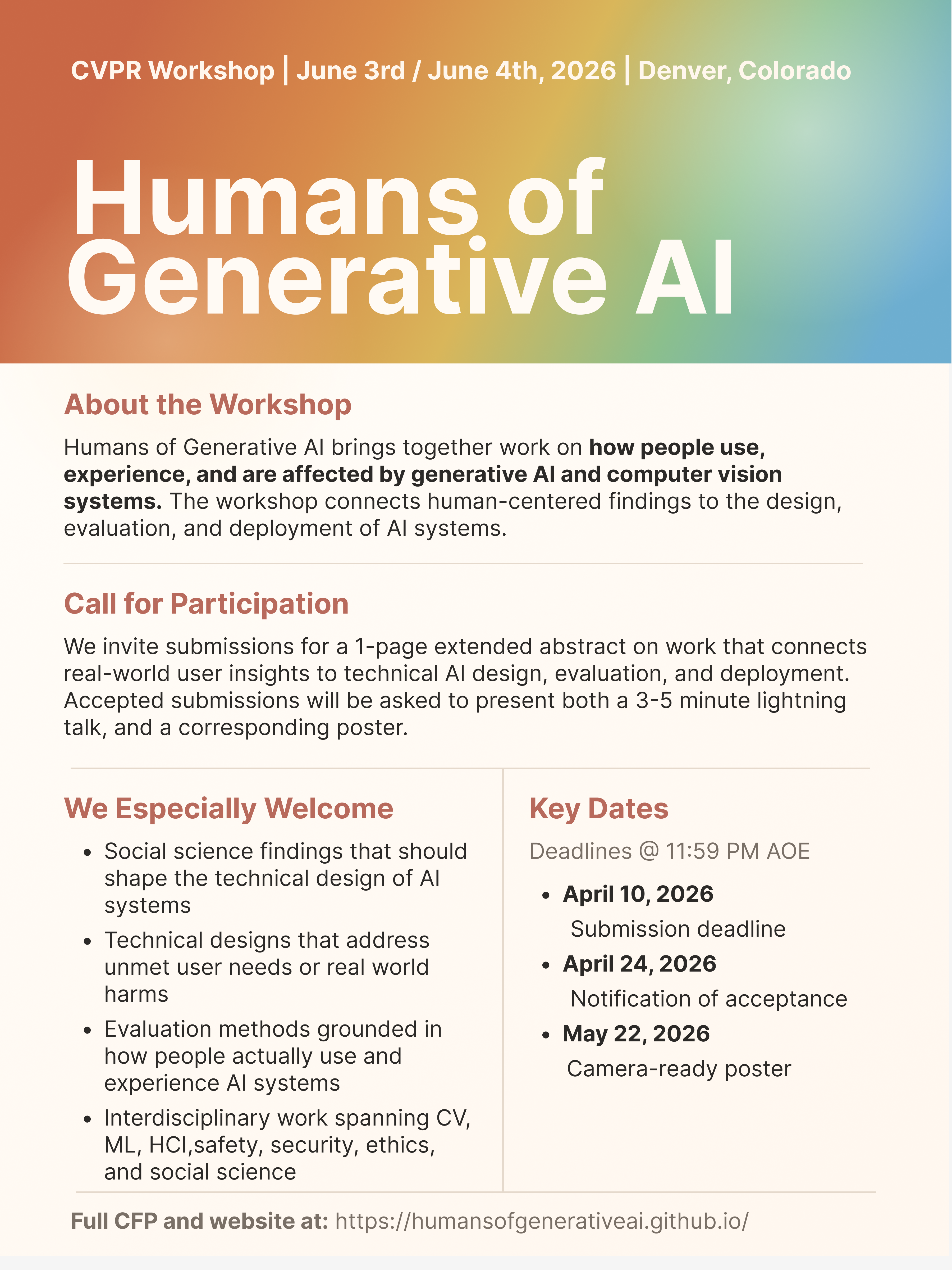
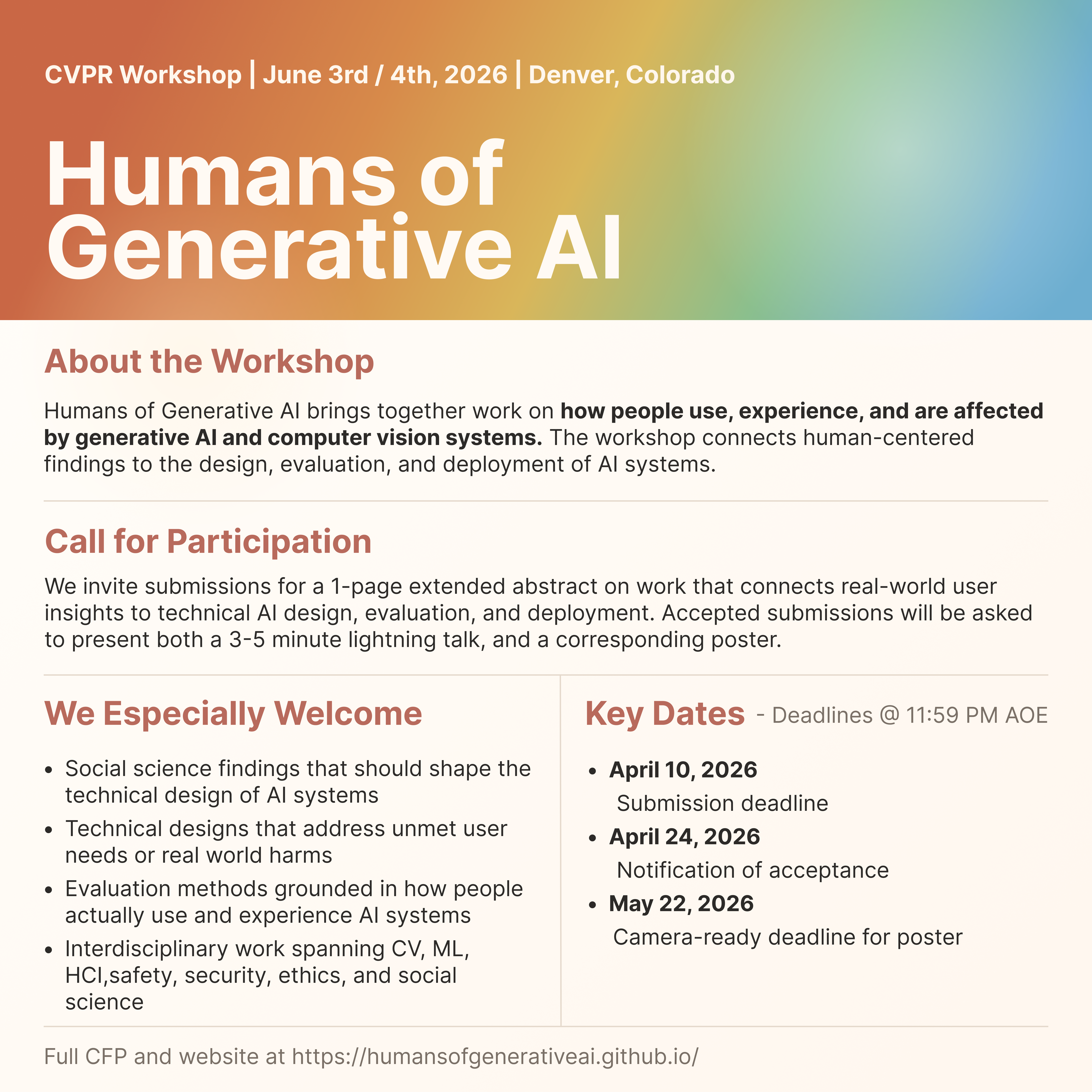
Download the workshop posters: Portrait Poster PNG and Square Social PNG.
Contact
For questions, email jaron.mink@asu.edu.